800G Has Already Won the Cost Argument. Here's What That Means for Your Next Refresh
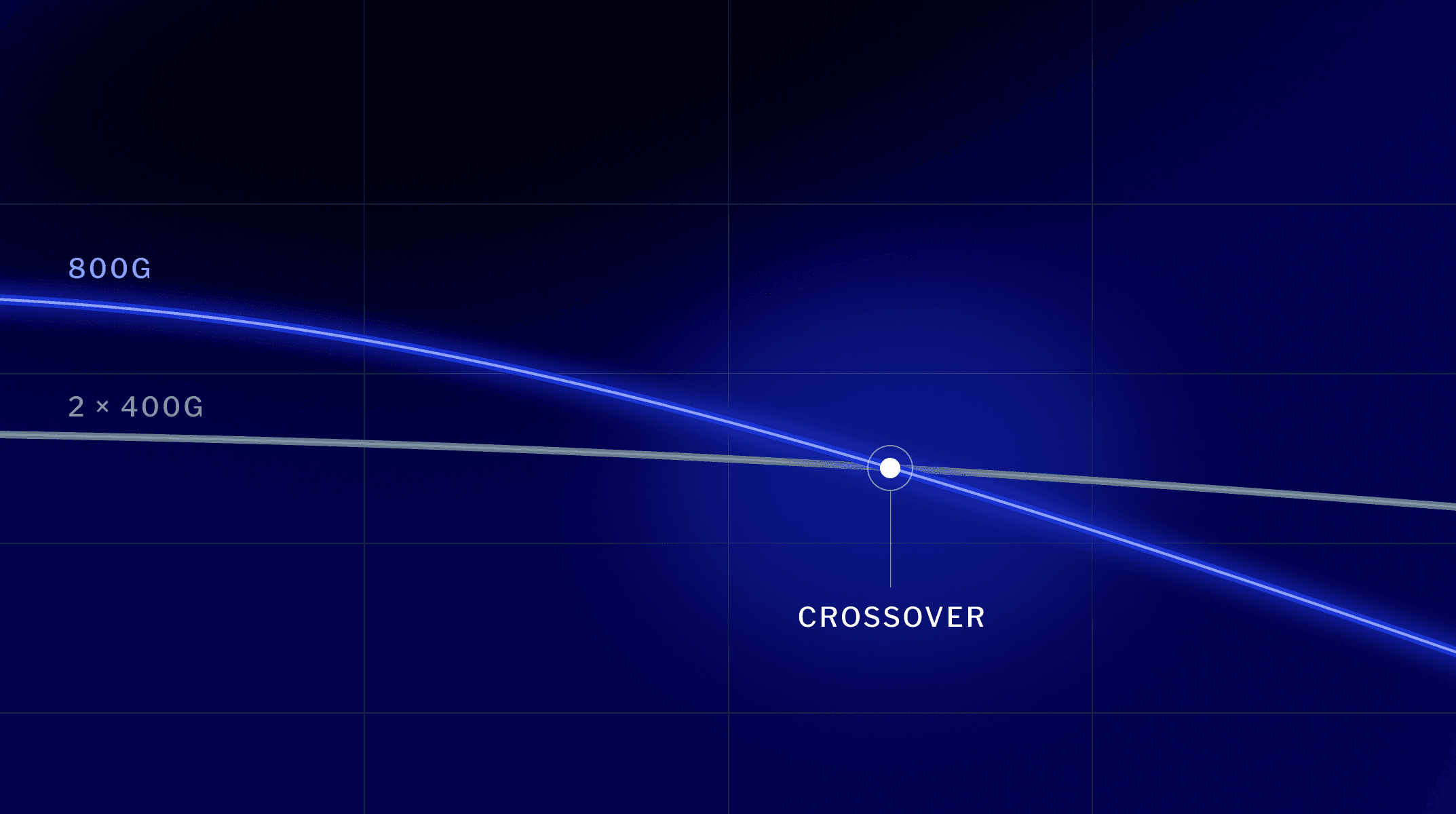
When you read articles about 800G OSFP transceivers, nearly all of them imply that the cost of 800G is significantly higher than 400G per bit, and that the only reason to adopt it is when you need the density, paying more for it in the process.
That was accurate two years ago. Now, not so much. The clearest way to show it is with real pricing rather than industry averages. At our current pricing, 800G OSFP now comes in cheaper per unit than the equivalent pair of 400G OSFP modules, not just at parity with them.
But the module was always the cheap half of the decision. The expensive half is the switch that drives it, and here is where the 800G vs 400G question actually gets decided. Once the price of the two modules stops being the deciding factor, what is left is the platform question: whether you are buying a new switch anyway, and if so, which one. In this article we will explain what that shift means, why it happened and when, and how far it is going to travel down the market.
Why 800G Arrived When It Did
The jump to 800G was not really a gradual increment. It mainly rested on one enabling step: 100Gbps per electrical lane.
An 800G OSFP module carries eight electrical lanes, each running at roughly 100Gbps with PAM4 modulation, for 800Gbps aggregate through a single port. This is the same structure that carried 400G when lanes ran at only 50Gbps, and it will most likely carry 1.6T when they reach 200Gbps. The lane count has been constant across these three generations; the only thing that changes is what the lanes can handle.
That also explains why the cost curve fell as fast as it did. 800G modules did not require any new form factors, new fiber infrastructure, or any new connector types. It uses the same architecture, just running faster, which meant the entire supply chain could scale into it rather than retool for it.
What the Numbers Actually Say
Most public comparisons still price 800G at a meaningful per-unit premium over 400G. Our own catalog, at current list pricing, tells a different story.
Across every reach class we carry, 800G OSFP now comes in cheaper per unit than the equivalent pair of 400G OSFP modules, not at parity, and not more expensive even for a true single 800G flow:
At 2km reach, an 800G 2xFR4 module costs roughly 60 percent less than two 400G FR4 modules at current list, for the same 800Gbps and the same reach, while consuming one switch port instead of two.
At 500m, an 800G 2xDR4 module comes in at roughly 48 percent less than two 400G DR4 modules, for the same capacity, in half the port count.
Even a true single 800G flow holds up: an 800G DR8 module, a genuine eight lane module on an MPO-16 connector rather than two independent 400G streams, still costs roughly 22 percent less than two 400G DR4 modules. The savings are not just a breakout-cable artifact; a straight single-link 800G port beats the 400G pair on its own.
The pattern holds whether the 800G port is split into two 400G streams or run as one native 800G link, which points to where the savings actually come from: not a breakout discount, but the broader cost curve for 100Gbps-per-lane silicon settling across the board.
Power tells the same story. A 400G SR4 module draws about 8W, so two of them run to roughly 16W combined, versus 14W for one 800G 2xSR4 module. That is about 12 percent less power for the same throughput, before accounting for the switch ports, line cards, and cooling those extra modules would have required.
The Other Half of the Bill That Decides It
Everything mentioned above only compares optics to optics, and for the most part that is only the smaller line on the invoice. The larger one is the switch, and it is the switch that determines whether the optics savings mean anything.
If you already own a platform that can carry 400G with free ports, two 400G OSFP optics give you 800Gbps of capacity for the price of two modules and nothing else. The 800G alternative costs those optics plus a new switch capable of delivering 100Gbps per lane on its ports, and no module level saving comes close to closing that gap. In that situation the answer is 400G, and it is not even close.
The comparison starts to mean something only when you are buying hardware regardless, and there are two versions to that story.
One possibility is that ports are already exhausted on the existing platform. Now the real comparison is a new 400G line card or switch plus 400G modules, against an 800G platform plus 800G modules. This is where port density stops being a spec sheet virtue and becomes money: half the ports for the same capacity means fewer line cards, fewer switches, fewer uplinks between them, and less power and cooling for the lot. The fact that the optics now cost less, not more, is what lets that density advantage show up as a net saving instead of being eaten by a module premium that no longer exists.
The other is a so called greenfield build, or a refresh already in the plan. The switch cost is committed either way, module cost already favors 800G, and the decision falls to density, power, and roadmap. 800G wins that on the numbers, and the module comparison above is what makes it a clean win rather than a trade-off.
So the honest framing is narrower than a blanket "800G is now cheaper." It is that the optics no longer hold the platform decision back, if anything they help it now, which means the decision can be made on density, power, and switch cost on their own merits. That is a genuinely different situation from two years ago, when the module premium alone was enough to rule 800G out of most budgets.
Why This Matters Beyond Your Own Rack
The likely reason 800G economics improved this fast is not that the optics industry became generous overnight. It is simply that AI infrastructure consumed enough volume to drag the entire cost curve down.
We covered why GPU fabrics need 800G at the spine and uplink layers in GPU cluster networking and optical transceivers. The point here is what that demand did to the rest of the market. It concentrated enormous volume into a narrow product range in a short time, and volume of that kind funds manufacturing scale, improves yields, and pulls component pricing down. None of those improvements stay confined to the customers who paid for them.
This is the part of the story worth understanding if you are not building an AI cluster. The hyperscale AI build out is effectively subsidizing the mainstream 800G transition. The modules that reach normal enterprise and service provider pricing over the next couple of years get there because someone else bought them in large volume first. It is the same mechanism that made 100G affordable, then 400G, and it is running faster in this cycle than in either of the previous two.
The Path to 1.6T
Continuity of expansion is a real part of the 800G case, and OSFP's roadmap supports it: 400G at eight lanes of 50G, 800G at eight lanes of 100G, and OSFP1600 at eight lanes of 200G. OSFP1600 maintains mechanical compatibility with existing OSFP cages and front panels. What that gives you is a stable form factor, front panel layout, cabling, and fiber plant across the next generation, not just a 1.6T capable port.
Reaching 1.6T still means a switch built on 200G per lane electrical interfaces, exactly as it was for reaching 800G from 400G.
OSFP-XD, on the other hand, is a separate path. Alongside OSFP1600, the MSA defines a higher lane count variant, OSFP-XD, and it is explicitly not compatible with the existing OSFP form factor. XD cages carry keying features specifically to prevent OSFP modules from being inserted, since doing so could damage the port. The larger connector is there to carry twice the lane count, sixteen lanes instead of eight, not to run each lane faster; OSFP1600 already reaches 200 Gb/s per lane inside the standard OSFP cage.
So an 800G OSFP decision genuinely protects your optic inventory and your fiber plant across a platform refresh, which is worth having. It is simply narrower than the way the roadmap is usually sold.
How the Mainstream Need Expands
400G remains the deployed majority across enterprise and cloud data centers, and as the year comes to an end that is unlikely to change. But the direction is consistent, and it follows a pattern the industry has run twice before.
800G enters at the spine and uplink layer, exactly where port exhaustion matters most, and then it works downward as pricing normalizes. Most organizations are not choosing between the two; they are running mixed fabrics, with 400G serving leaf-spine capacity and 800G carrying the dense uplinks above it.
The mechanism that makes this work, and the strongest practical argument for buying 800G before the rest of your fabric is ready, is breakout. An 800G port splitting to 2 × 400G or 8 × 100G serves both eras from one module. You are not stranded if the layer below stays at 400G for another three years, and you are not forced into a wholesale migration to benefit from the port you bought.
So When Does It Make Sense
800G is the clear call where port capacity is a live constraint rather than a forecast, where rack power or cooling limits how many switches you can add, and where the platform is built on silicon that makes the investment last. AI and HPC fabrics hit all three routinely.
If you have a 400G platform with ports to spare, stay on it. Nothing in this article argues for replacing a working switch to chase a module-level saving that does not exist.
Otherwise, for anyone refreshing a spine, planning uplinks, or specifying a new build in the next twelve months: the case has become considerably stronger than it was, and it will keep strengthening. The optics no longer carry a premium, if anything they run cheaper today, which means the platform decision can now be made on density, power, and roadmap rather than being held back by module pricing. And the module that gives you 800 Gbps today can give you two 400G ports tomorrow if that is what the fabric needs.

EDGE Technologies
Expert in telecommunications and data center technologies, sharing insights on the latest industry trends and innovations in optical networking solutions.